
A marina and boat storage brokers guide for owners
Updated May 27, 2026. Written by Peter Meyer, founder of Marina Brokerage Services.
Selling a boat storage facility is not like selling an apartment building or a self-storage warehouse. The buyer pool is narrower, the diligence is more technical, and the value drivers — submerged-land leases, USACE permits, hurricane underwriting, slip and rack contracts — sit nowhere on a generalist broker’s checklist.
Marina Brokerage Services helps owners sell boat storage facilities, dry stacks, marinas, boatyards, and marine commercial real estate across the United States, the Caribbean, and the Bahamas. Founder Peter Meyer is a Houston-based marina and boat storage broker, principal of Gulf Commercial Brokerage, LLC, and licensed by the Texas Real Estate Commission.
This guide explains exactly how to sell your boat storage facility in 2026 — what it’s worth, how the process works, who’s buying, and what to fix before you list.
📞 Talk to a specialized boat storage broker. Request a free, confidential Broker Opinion of Value or call/text Peter directly at (713) 320-9651.Why work with a specialized boat storage and marina broker?
Most commercial real estate brokers can list a boat storage facility. Almost none can price it accurately, market it to the right buyers, or close it without leaving money on the table.
The reason is simple: boat storage and dry stack facilities sit at the intersection of four worlds — self-storage economics, marina hospitality, marine engineering, and waterfront entitlement law. A generalist broker is fluent in zero of the four. A specialist is fluent in all four.
What a specialized marina broker does that a generalist won’t
- Prices the asset using the right cap rate. Boat storage facilities trade 50–150 basis points wide of traditional self-storage. Get the cap rate wrong and the seller leaves $500K to $2M on the table.
- Knows the active buyer pool. PE-backed boat & RV storage platforms and marina platform operators don’t respond to generic LoopNet listings. They respond to broker relationships.
- Manages confidentiality. Pocket listings, NDA-gated buyer outreach, blind teasers — the tools that protect slip-holders, staff, and supplier relationships during a sale.
- Anticipates the marine-specific deal-killers. Submerged-land lease assignability, Phase I environmental, USACE permit transfers, hurricane and flood underwriting, dock and rack condition, fuel system compliance.
- Closes the deal. Marina transactions stall in due diligence more than any other CRE asset class. A specialist anticipates the questions and heads off the re-trade.
How are boat storage and dry stack facilities valued in 2026?
Three valuation methods drive boat storage and marina pricing. The income approach sets the price; replacement cost and highest-and-best-use serve as cross-checks.
The income approach: NOI ÷ cap rate
This is the workhorse method. The buyer takes annual net operating income (NOI) — gross revenue minus operating expenses, before debt service and depreciation — and divides by an appropriate capitalization rate (cap rate).
NOI ÷ Cap Rate = Property Value
A dry stack producing $850,000 in annual NOI at a 7.0% cap rate is worth roughly $12.1 million. Push the cap rate to 7.5% and the same property is worth $11.3 million. A 50-basis-point swing equals $800,000. That is why the cap rate argument with the buyer is the single most important conversation a marina broker has.
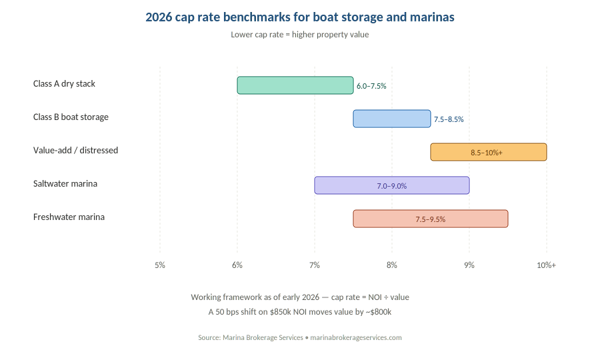
Current cap rate benchmarks for dry stack and boat storage
As of early 2026, our working framework:
- Class A dry stack and boat storage (modern, hurricane-rated, automated, prime location): 6%–7.5%
- Class B boat storage (functional, stabilized, manageable deferred maintenance): 7.5%–8.5%
- Value-add or distressed: 8.5%–10%+
- Saltwater marinas (mixed revenue: slips, fuel, service, dry stack, retail): 6.5%–9.0%
- Freshwater marinas on owned land: 7.5%–9.5%
Dry stack facilities trade at slightly tighter cap rates than open boat storage because they combine storage economics with the structural scarcity of waterfront access.
Replacement cost and highest-and-best-use
Replacement cost matters for newer facilities still in lease-up (where current NOI understates stabilized value) and for under-improved sites a buyer might tear down. Highest-and-best-use matters when upland has development optionality — mixed-use, multifamily, hospitality — exceeding the marina’s value alone. A specialist runs all three frameworks and presents the buyer with the one that produces the highest defensible price.
H2: The 8-step process for selling a boat storage facility
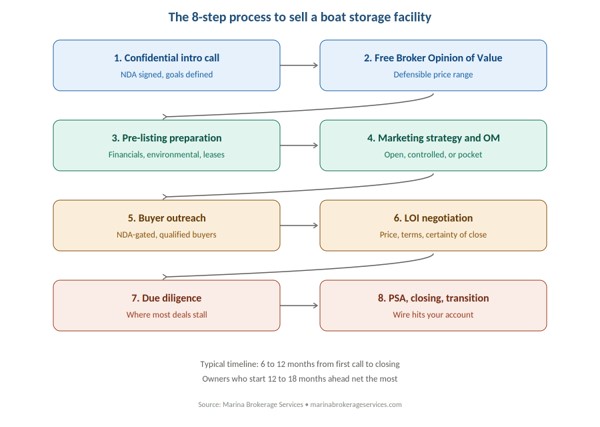
Step 1 — Confidential intro call and NDA
A 30-minute phone call. Mutual NDA before you share anything sensitive. We define your goals, timeline, and red lines.
Step 2 — Free Broker Opinion of Value (BOV)
A written Broker Opinion of Value — typically a 5–15 page document with a defensible value range, comp set, market analysis, and recommended sale strategy. Free. No obligation. Some owners use the BOV simply to make a hold-versus-sell decision. That’s fine.
Step 3 — Pre-listing preparation
Thirty to ninety days of getting the asset ready for market: clean financials, environmental review, deferred maintenance triage, lease and permit audit, owner add-back schedule. Properties that go to market well-prepared close faster and at higher prices.
Step 4 — Marketing strategy and offering memorandum
Open process controlled marketed process, or true pocket listing — together we decide. We build the offering memorandum (a 30–50 page institutional-quality document) and a confidential teaser for initial buyer outreach.
Step 5 — Buyer outreach
Direct approach to the buyer pool: institutional platforms, family offices, marina operators, strategic local buyers. Every prospect signs an NDA before receiving the OM. We field every inquiry so you don’t have to.
Step 6 — LOI negotiation
Letters of intent come in. We negotiate price, earnest money, due diligence period, financing contingencies, and timeline. The highest price is not always the best LOI — certainty of close matters more than the headline number.
Step 7 — Due diligence
The stage where 30–40% of marina deals stall. The buyer inspects financials, environmental reports, permits, leases, dock and rack condition, and legal compliance. We manage the data room, anticipate the questions, and head off problems before they become re-trades.
Step 8 — Purchase and sale agreement, closing, transition
PSA negotiated, closing scheduled, pro-rated adjustments for prepaid slip fees and storage contracts, transition of staff and operating systems if you remain involved post-close. Wire hits your account.
Total timeline: 6 to 12 months from first conversation to closing. Owners who start the conversation 12–18 months before they want to close end up netting more.
What should I fix before I list my boat storage facility for sale?
The single biggest predictor of how a marina or boat storage sale ends is how prepared the seller is when the property hits the market. Here is the pre-listing checklist we run with every owner.
Clean three years of financials
P&Ls, balance sheets, tax returns. Reconciled rent rolls and slip occupancy. Owner add-back schedule that cleanly separates personal expenses from business operations. Buyers and their lenders walk away from messy books.
Order a Phase I environmental report
If your facility has fueling, repair yard activity, paint or hull work, or is more than 30 years old, Phase I is now standard buyer due diligence. Known issues with a remediation plan are far better than surprises in due diligence.
Audit your submerged-land lease and ground lease
Texas GLO, Florida BPL, USACE permit, municipal lease, private ground lease — every term needs to be current and every assignment provision needs to be understood. Lease assignability is the single most common deal-killer in marina transactions.
Confirm permit currency
USACE Section 10/404 permits, state water-quality permits, dredging permits, fueling permits. All current. All transferable.
Triage deferred maintenance
You don’t need to renovate. Address the items that will show up in a buyer’s inspection report and trigger a re-trade — failing dock electrical, broken racks, non-functional forklifts, derelict boats, dilapidated bath houses. Fix where the cost-to-fix is materially less than the price hit you’ll take in re-trade.
Standardize slip and rack contracts
Standardized agreements, rent rolls reconciled, prepaid balances tracked. Buyers underwrite recurring revenue at a discount when contracts are inconsistent.
Special situations: leased land, environmental, hurricane risk
These are the issues that determine whether your sale clears at the top or the bottom of the value range.
How do I sell a marina or boat storage facility on leased land?
Marinas frequently sit on submerged-land leases (state) or upland ground leases (private or municipal). Buyer underwriting depends on remaining term, renewal options, escalation clauses, and assignment rights. We have closed multiple deals on leased land — including the Lake Somerville Marina and Campground sale.
Selling a Texas Gulf Coast marina with a GLO submerged-land lease
If you operate a Texas Gulf Coast marina, your submerged land is likely leased from the Texas General Land Office. Lease transfers require GLO approval, and the timeline matters. We handle this routinely.
Selling with the boat dealership, brokerage, or fuel dock attached
Operating businesses can be sold separately from the real estate, or together — depending on what produces the highest combined price. We model both.
Hurricane and flood risk underwriting
Post-Harvey, post-Ian, and post-Helene, buyer scrutiny on coastal facilities has intensified. Insurance availability, FEMA flood zone classification, building elevation, and hurricane-rated construction all affect both pricing and the buyer pool. Inland reservoir facilities are increasingly attractive partly for this reason.
Environmental contamination from prior operations
Historic boatyards, fueling, blasting, painting, and bilge handling can leave legacy contamination. Disclosed and managed, it is a manageable issue. Undisclosed and discovered in due diligence, it is a deal-killer.
Strategic vs. financial buyer: who pays more?
A strategic buyer (an existing marina operator) sometimes pays the highest price because of synergies. A financial buyer (a PE-backed platform or family office) sometimes pays the highest price because of cap rate compression and platform multiple. Knowing which fits your specific asset is part of the broker’s job.
1031 exchange when selling a marina or boat storage
Many marina sellers exchange into another marina, dry stack, RV park, or income property to defer capital gains. The IRS rules require identifying the replacement within 45 days and closing within 180 days. We work with qualified intermediaries who specialize in marine and recreational asset exchanges.
Who buys boat storage facilities and dry stacks today?
The buyer universe in 2026 is broader and deeper than it has ever been. The right broker accesses all of it; the wrong broker accesses one slice.
-
PE-backed boat & RV storage platforms:
Aggregating Class A storage at scale.Natural acquirers of larger, modern dry stacks.
-
Marina platform operators:
Acquiring saltwater and freshwater marinas, often paying premium prices for strategic geographic fit.
-
Family offices and high-net-worth individuals:
Single-property assets in the $3–25 million range. Often local or regional. Frequently the highest bidder for a specific property because the asset is also a lifestyle.
-
REITs at scale
Selectively. Public Storage’s $10.5 billion acquisition of National Storage Affiliates announced in March 2026 is the clearest signal yet that the broader storage complex (including boat and RV) is a permanent institutional asset class.
-
Local strategic buyers
Existing marina or dry stack operators expanding their footprint. Often quick to close, often financing-light.
-
International capital
Selectively for trophy assets. Active relationships in the Bahamas, Caribbean, Mexico, and beyond.
Timeline, broker commission, and net proceeds
A typical sale of a boat storage facility, dry stack, or marina runs 6 to 12 months from first conversation to wire transfer.
| Stage | Typical duration |
| Pre-listing preparation | 30–90 days |
| Marketing and LOI negotiation | 60–120 days |
| Due diligence | 60–120 days |
| PSA to closing | 30–45 days |
Broker commission is a percentage of sale price, scaled to deal size, and fully negotiable. We discuss the fee transparently in the first conversation.
Net proceeds = sale price − debt payoff − broker fee − closing costs (title, legal, environmental, transfer taxes) − pro-rated adjustments for prepaid slip and storage fees − capital gains tax (unless deferred via 1031).
For most sellers, the right broker pays for themselves several times over because the price uplift from a competitive process exceeds the commission by a wide margin. Veteran broker Robert Griesbauer put it this way in Marina Dock Age: you’ll do better on a net basis paying a broker fee than taking the first offer that walks through the door.
Confidentiality and pocket listings
Most boat storage and marina owners we work with want to protect staff, slip holders, suppliers, lenders, and competitors from finding out the property is for sale until they decide who should know. Marina Brokerage Services runs a confidential process by default:
- Blind teasers that do not name the property or seller
- NDA-gated offering memoranda
- Pocket listings never publicly marketed, only shown to a curated buyer set
- Strategic buyer outreach where we tell the buyer exactly enough to evaluate and not a word more
Many of our active mandates do not appear on our Listings page or on any public platform.
Why Peter Meyer and Marina Brokerage Services?
Peter Meyer is the founder and principal broker of Marina Brokerage Services and Gulf Commercial Brokerage, LLC. Houston-based. Texas Real Estate Commission licensed but provides a nationwide reach.
Recent representative transactions:
- Closed: Lake Somerville Marina and Campground — 168 acres, 88 covered slips, 109 RV sites, between Houston and Austin.
- Active: Westernport Marina — Hastings, Australia. ~590 berth-equivalent institutional-scale marina asset.
What clients consistently tell us they value: real subject-matter depth, no pretense, complete confidentiality, honest valuations (we will tell you when not to sell), and a process designed around the seller’s specific goals.
📞 Ready to talk? Request a free, confidential Broker Opinion of Value. Typically a one-business-day response. Or call/text Peter directly at (713) 320-9651.Frequently asked questions about selling a boat storage facility
How much is my boat storage facility worth?
A boat storage facility is typically valued by dividing annual net operating income (NOI) by a market capitalization rate. As of early 2026, cap rates run 6.0%–7.5% for Class A dry stack, 7.5%–8.5% for Class B boat storage, and 8.5%–10%+ for value-add. The most reliable way to determine your facility’s value is a free Broker Opinion of Value.
How do I sell my boat storage facility?
Engage a specialized marina and boat storage broker. The process runs 6–12 months: confidential intro and BOV, 30–90 days of pre-listing preparation, 60–120 days of marketing and LOI negotiation, 60–120 days of due diligence, and 30–45 days from purchase and sale agreement to closing.
What is a Broker Opinion of Value (BOV) for a marina?
A Broker Opinion of Value is a written valuation document — 5 to 15 pages — with a defensible value range, comparable sales, market analysis, and a recommended sale strategy. Marina Brokerage Services provides BOVs free of charge for boat storage, dry stack, marina, and boatyard owners.
How long does it take to sell a marina or boat storage facility?
Four to twelve months from first conversation to closing is typical: 30–90 days of pre-listing preparation, 60–120 days of marketing and LOI negotiation, 60–120 days of due diligence, and 30–45 days from purchase and sale agreement to closing. Owners who begin the conversation 12–18 months before they want to close net the most.
How is confidentiality maintained when I sell my marina?
Marina Brokerage Services runs a confidential process by default. Blind teasers that do not name the property, NDA-gated offering memoranda, and — for owners who request it — true pocket listings never publicly marketed. Most active mandates are not visible on any public listing platform.
Do I need a Phase I environmental report before listing my boat storage facility?
If your facility has fueling operations, repair yard activity, paint or hull work, or is more than 30 years old, yes. Phase I is now standard buyer due diligence on marine assets. Known issues with a remediation plan are far better than surprises during the buyer’s inspection.
Can I sell my marina if it sits on a leased submerged-land or ground lease?
Yes. Leased-land marinas trade routinely. Keys are remaining lease term, renewal options, escalation clauses, and assignment rights. Buyers underwrite leased-land marinas at a modest discount to fee-simple comparables — manageable when the lease is well-structured and the assignment process is understood. Texas GLO submerged-land leases transfer routinely with state approval.
What is the typical broker commission on a marina or boat storage sale?
Commission is a percentage of the sale price, scaled to deal size, and fully negotiable. We discuss the fee transparently in the first conversation. Sellers consistently net more working with a broker — the price uplift from a competitive process typically exceeds the commission by a multiple.
Can I do a 1031 exchange when I sell my boat storage facility?
Yes. Many marina, dry stack, and boatyard sellers exchange into other income-producing real estate to defer capital gains tax. IRS rules require identifying the replacement property within 45 days and closing within 180 days. We work with qualified intermediaries who specialize in marine and recreational asset exchanges.
How do I prepare my boat storage business for sale?
Clean three years of financials, complete a Phase I environmental review, audit your ground or submerged-land lease and all permits, address material deferred maintenance, standardize slip and rack contracts, and prepare a clear owner add-back schedule. We provide a detailed pre-listing checklist with every Broker Opinion of Value engagement.
When is the best time to sell my marina or boat storage facility?
When NOI is at or near its trailing peak, deferred maintenance is manageable, and lease and permits are current. Macro conditions matter too: cap rates, debt availability, and institutional appetite. As of early 2026, transaction activity is recovering, rent growth has turned positive, and institutional capital has returned to the sector — a constructive environment for well-prepared sellers.
What if I’m not sure I want to sell yet?
A reasonable place to start. Many owners we work with begin the conversation 12–24 months before they actually transact. A free Broker Opinion of Value gives you an accurate picture of what your facility is worth today, what the market environment looks like, and what you would do to maximize value. No obligation.
Talk to a boat storage broker
If you own a boat storage facility, dry stack, marina, or boatyard and want a confidential conversation about a potential sale — or simply want to know what your property is worth — we’d like to hear from you.
Request a free Broker Opinion of Value → /contact Or call/text Peter directly: (713) 320-9651Marina Brokerage Services • 5300 Memorial Dr., Suite 1100, Houston, TX 77007
─────────────────────────────────────
Sources: Yardi Matrix (boat & RV storage facility counts and transactions), National Marine Manufacturers Association (NMMA), RV Industry Association (RVIA), Toy Storage Nation (Class A boat & RV storage research), Cushman & Wakefield H1 2025 Self-Storage Cap Rate Survey, Marina Dock Age. Cap rate ranges are working frameworks based on recent market activity and are not investment advice.