
Why Work With a Specialized Marina and Boat Storage Broker?
Written by Peter Meyer, founder of Marina Brokerage Services.
Most commercial real estate brokers can list a marina, boat storage facility, or boat-related business. Almost none can price it accurately, market it to the right buyers, or close it without leaving money on the table. The reason isn’t effort — it’s category. Marinas, dry stacks, and boatyards sit in a transactional niche where the people writing the largest checks don’t respond to LoopNet, the most important deal terms aren’t in the standard CRE playbook, and the issue most likely to kill the trade is a clause buried in a state submerged-land lease most lawyers have never read.
This is the page that explains why a specialized marina and boat storage broker produces a materially different outcome than a generalist commercial real estate broker, a self-storage broker, or a business broker — and how to tell the difference before you sign a listing agreement.
Want a confidential conversation about your facility? Call/text Peter Meyer directly at (713) 320-9651 or request a free Broker Opinion of Value at /contact.
Why Selling a Marina or Boat Storage Facility Requires a Specialist
Boat storage and marina assets sit at the intersection of four professional disciplines, and a transaction touches all four. A generalist who can fluently speak only one or two of them — usually CRE — will systematically underprice the asset, fail to identify the strongest buyers, and lose deals in due diligence to issues a specialist would have flagged in week one.
The Marina Hospitality Discipline
Slip and rack contracts. Fuel margins. Service revenue. Boat club arrangements. Restaurant and ships-store income. Seasonality. Live-aboard tenants. Slip-holder relationships and the political dynamics of telling them the property might sell. None of this is on the traditional broker’s radar — and most of it is invisible to a CRE broker.
The Self-Storage Discipline
How recurring storage revenue is underwritten. NOI normalization. Economic vs. physical occupancy. Owner add-backs. Cap rates by class and market. Every modern boat storage facility is, at one level, a self-storage business — and the self-storage industry has spent two decades professionalizing valuation methodology that a generalist CRE broker has not been trained on.
The Marine Engineering Discipline
Dock condition, including fixed vs. floating, age, and electrical systems. Forklift age and maintenance status on a dry stack. Rack capacity and structural rating. Fuel system condition and EPA compliance. Boatyard equipment. Bulkheads, breakwaters, and erosion control. Each of these is a buyer due-diligence item that becomes a re-trade demand if the broker hasn’t anticipated it.
The Waterfront Entitlement Discipline
USACE Section 10/404 permits. State water-quality permits. Submerged-land leases — Texas GLO, Florida BPL, USACE, municipal. Riparian rights. FEMA flood zones. Hurricane construction codes. Lease assignability is a very common deal-killer in marina transactions, and it lives entirely in this discipline. A generalist broker discovers these issues in due diligence; a specialist surfaces them before the property goes to market.
Each discipline alone takes years to learn. The intersection — knowing how a Phase I finding affects a cap rate, how a GLO lease affects buyer access, how slip-contract structure affects underwriting NOI — is what a specialist brings and a generalist can’t replicate, regardless of effort.
Specialized Marina Broker vs. Generalist CRE Broker vs. Business Broker
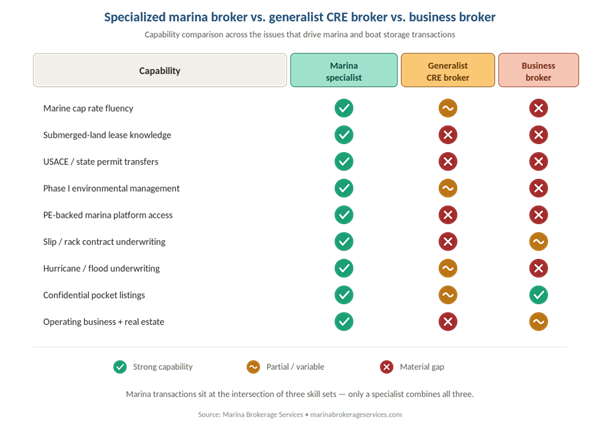
Three types of broker pitch marina owners and boat storage operators. Here is what each actually delivers.
The Generalist Commercial Real Estate Broker
Strong on market comps for office, retail, industrial, and multifamily. Weak everywhere a marina is different from those four asset classes. A generalist will list the property and market it through standard CRE channels, applying the same pricing and marketing frameworks used for traditional asset classes. Result: the asset reaches a fraction of the real buyer pool, the cap rate argument with buyers is weak, and surprises in due diligence trigger re-trades.
The Business Broker
Strong on operating business sales — restaurants, dealerships, service businesses. Weak on the real estate side. Often values the marina as a multiple of EBITDA without correctly accounting for the underlying real property, the ground lease, or the institutional buyer pool that prices off cap rate, not multiple. Result: undervaluation of the real estate component, often the largest part of the asset, and a buyer pool limited to small-business buyers rather than institutional capital.
The Specialized Marina and Boat Storage Broker
Combines all three skill sets: real estate valuation discipline, operating-business EBITDA fluency, and marine-specific knowledge of leases, permits, and physical infrastructure. Result: the asset gets priced using the right framework, marketed to the full institutional and strategic buyer universe, and shepherded through diligence by someone who anticipates the marine-specific issues before the buyer raises them.
Marina Brokerage Services exists because Peter Meyer recognized — after years of watching marina deals get listed by good CRE brokers and lose 10–20% of value to avoidable mistakes — that this niche needed a dedicated specialist platform. Because of this, as well as a love for water and boats, this is the entire reason the firm exists.
What a Specialized Marina Broker Actually Does Differently
Five places where the work product is materially different. Each one moves the final sale price by a meaningful amount.
Pricing the Asset Using the Right Cap Rate
Boat storage and dry stack facilities trade 50–150 basis points wide of traditional self-storage. The exact spread depends on facility class, market, hurricane exposure, and lease structure. A generalist applies a self-storage cap rate or a generic income-property cap rate. A specialist builds the cap rate argument from specific recent marine transaction comps and presents it to the buyer with the data to defend it.
Example: On $850,000 of NOI, a 7.0% cap rate produces approximately $12.1 million of value; a 7.5% cap rate produces approximately $11.3 million. Roughly $800,000 of value moves on a 50-basis-point argument. That argument is what a specialist wins.
Reaching the Right Buyer Pool
There are six active buyer categories for marina and boat storage assets in 2026. A generalist CRE broker has relationships in one or two — typically family offices and local strategic buyers. A specialist maintains active dialogue across all six:
- Marina platform operators
- PE-backed boat and RV storage platforms
- Family offices and high-net-worth individuals
- REITs at scale
- Local strategic buyers
- International capital
Reaching three pools instead of one, in a competitive process, lifts price by far more than the difference in commission.
Managing Confidentiality the Way Owners Actually Need
Most marina owners we work with care intensely about staff, slip holders, suppliers, lenders, and competitors not finding out the property is for sale. Standard CRE marketing — public LoopNet listing, MLS posting, signage — is the opposite of what these owners need. A specialist runs a confidential process by default: blind teasers, NDA-gated offering memoranda, and true pocket listings shown only to a curated buyer set.
Surfacing Marine-Specific Deal-Killers Before They Kill the Deal
Submerged-land lease assignability. Phase I findings on legacy fueling or hull-paint operations. Non-current USACE permits. Hurricane and flood underwriting. Slip-contract inconsistency. Dock electrical condition. These are the issues that 30–40% of marina deals stall on in due diligence. A specialist identifies them in week one of the engagement, builds the remediation plan into the offering memorandum, and prevents the buyer from using them as a re-trade lever later.
Building the Offering Memorandum Institutional Buyers Actually Read
Institutional buyers — PE platforms, family offices, REITs — will not seriously evaluate an asset without an institutional-grade offering memorandum. That means a document with normalized financials, owner add-back schedule, market analysis, deal and location descriptions, environmental and permit summary, lease terms, capex projections, and a proper underwriting model. A generalist CRE broker typically produces a marketing flyer. The difference shows up directly in the bid sheet.
Why Marina Brokerage Services and Peter Meyer Specifically
Houston-based. Texas Real Estate Commission licensed. Founder of Gulf Commercial Brokerage, LLC. Strategic partnerships with Park Brokerage Services and Gulf Commercial Group — extending reach across the Americas, Caribbean, and Bahamas.
Recent representative transactions:
- Closed: Lake Somerville Marina and Campground, Brenham, Texas. 168 acres. 88 covered slips. 109 RV sites. A turnkey waterfront destination between Houston and Austin. See the case study under News.
- Active: Westernport Marina, Hastings, Australia. Approximately 590 berth-equivalent. Institutional-scale, full-service marina and marine services asset. Listed by Marina Brokerage Services for international institutional buyers.
What clients tell us they value:
- Real subject-matter depth. Peter is an active boater. The lifestyle is the work. The depth is real, not performed.
- No pretense. Marina Brokerage Services is not the largest brokerage. It is the most focused. Pick the largest if scale is your priority. Pick us if specialization is.
- Complete confidentiality. Most active mandates do not appear publicly anywhere.
- Honest valuations. If the market doesn’t support a sale at the price you need, we will tell you. Several of our most successful client relationships started with a free BOV that recommended the owner not sell yet.
- A process designed around the seller. Highest price, fastest close, or quietest exit — pick the goal, we structure to it.
When a Generalist Broker Might Actually Be Fine
Honesty matters here. Not every marina sale needs a specialist. A generalist CRE broker can be perfectly adequate when:
- The asset is small, the buyer pool is local, and the deal economics don’t justify a specialist’s involvement.
- The seller has already identified the buyer and just needs transaction management.
- The property is being marketed primarily for its real estate optionality — for example, a small marina being sold for redevelopment as multifamily — where the marina is incidental to the deal.
In all other cases — multi-million-dollar facilities, multiple potential buyers, ongoing operations, ground or submerged-land leases, dry stack components, or any complexity at all — the question isn’t whether specialization pays for itself. It’s how much value a generalist would leave on the table.
How to Tell if a Marina Broker Is Actually a Specialist
Anyone can put “marina specialist” on a website. Five questions reveal whether the specialization is real:
How Many Marina, Dry Stack, or Boatyard Transactions Have You Closed in the Last Five Years?
Fewer than three is concerning. A real specialist closes deals in this asset class regularly. Listings count for less than closings — anyone can list a marina; closing is the test.
Walk Me Through How You’d Value My Facility
A specialist will talk about NOI normalization, the cap rate spread between asset classes, applicable comparable transactions, lease structure, environmental considerations, and highest-and-best-use cross-checks.
Which Institutional Buyers Are Active in My Region Right Now?
A specialist names them and can speak to which ones are likely a fit for the specific asset. A generalist will say something vague about “investor networks.”
How Will You Handle Confidentiality?
A specialist defaults to confidentiality. Blind teasers, NDA-gated OMs, and optional pocket listings. A generalist will default to public marketing because that’s the standard CRE playbook.
What’s Your View on Submerged-Land Lease Assignability for My Specific Lease?
If the broker doesn’t immediately understand the question, they’re not a specialist.
Frequently Asked Questions About Hiring a Marina Broker
Why Hire a Specialized Marina Broker Instead of a Regular Commercial Real Estate Broker?
A specialized marina and boat storage broker prices the asset using the right cap rate framework, accesses all six active buyer pools, runs a confidential process, and surfaces marine-specific deal-killers, including submerged-land leases, USACE permits, Phase I findings, and hurricane underwriting, before they end the deal.
What’s the Difference Between a Marina Broker and a Business Broker?
A business broker focuses on the operating business, including slip revenue, fuel margin, and service income, and typically values it as an EBITDA multiple. A marina broker handles both the operating business and the underlying real estate, which usually represents the larger share of value, and prices the asset using the cap rate framework institutional buyers actually use.
Are Marina Broker Commissions Higher Than Regular CRE Commissions?
Not necessarily. Marina broker commissions are typically a percentage of sale price — broadly in line with other CRE asset classes. The price uplift from a specialist’s process and buyer access typically exceeds any commission difference by a wide margin.
Can a Self-Storage Broker Handle a Boat Storage or Dry Stack Sale?
Self-storage brokers understand the storage economics and have some buyer-pool overlap. But they typically lack the marina-specific knowledge — submerged-land leases, USACE permits, dock and rack engineering, hurricane underwriting, slip and rack contracts. Boat storage adjacent to or part of a marina almost always benefits from a marine specialist.
What If I Already Have a Relationship With a Generalist CRE Broker?
Many marina owners do. Some have their generalist co-broker with a specialist — the generalist maintains the client relationship while the specialist runs the technical work and the buyer process. Marina Brokerage Services routinely co-brokers when that structure produces the best result for the seller.
How Long Has Marina Brokerage Services Been in Business?
Marina Brokerage Services was founded by Peter Meyer as the dedicated marine-asset platform of Gulf Commercial Brokerage, LLC. It operates through strategic partnerships with Park Brokerage Services and Gulf Commercial Group to provide specialized marine real estate brokerage across the Americas, Caribbean, and Bahamas.
Is Marina Brokerage Services Licensed to Handle Transactions Outside Texas?
Yes. Through partner-firm relationships and broker-of-record arrangements, Marina Brokerage Services handles marina, dry stack, boatyard, and marine-related transactions across the United States, the Caribbean, and the Bahamas. The current active mandate set includes assets as far afield as Australia.
Can You Help Me Even If I’m Not Sure I Want to Sell Yet?
Yes. Many of the owners we work with begin the conversation 12–24 months before they actually transact. A free Broker Opinion of Value gives you an accurate picture of what your facility is worth today, what the market environment looks like, and what you’d do to maximize value. No obligation.
Talk to a Specialized Marina and Boat Storage Broker
If you own a boat storage facility, dry stack, marina, or boatyard and want to talk to a broker who actually specializes in this asset class — confidentially, with no obligation — we’d like to hear from you.
Request a free Broker Opinion of Value: /contact
Or call/text Peter directly: (713) 320-9651
Marina Brokerage Services • Gulf Commercial Brokerage, LLC • 2229 San Felipe, Suite 1400, Houston, TX 77019
Continue Reading:
- How to sell my boat storage facility — the complete seller’s guide, including valuation, process, and what to fix before listing
- Buying and developing on leased land — our deep-dive on submerged-land and ground leases, the single most common marina deal-killer
- Lake Somerville Marina case study — how Marina Brokerage Services closed a 168-acre full-service Texas marina